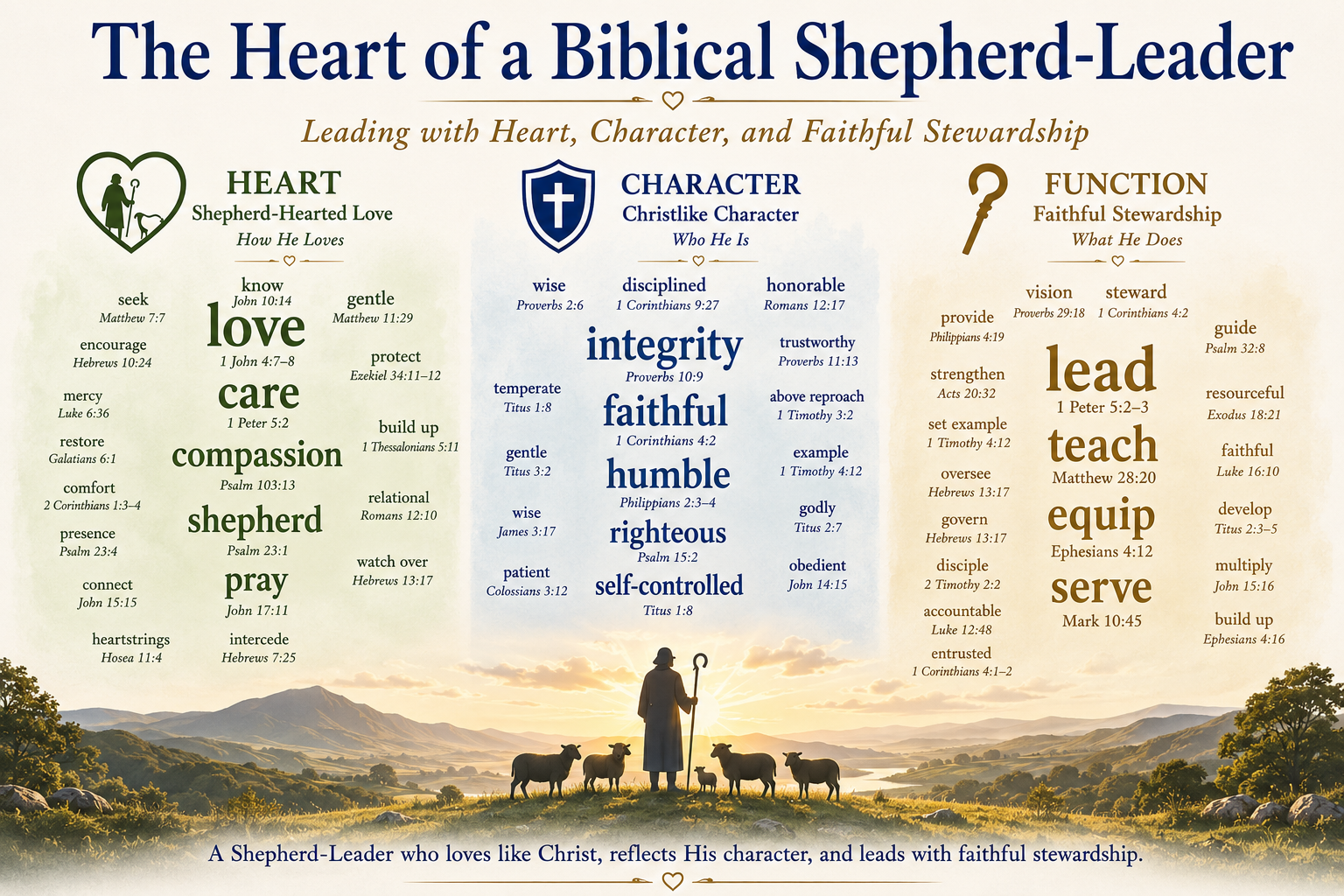
What I Have Learned About Leading People Well
Introduction
For much of my life, I believed leadership was largely about having the right answers. That came naturally to me as an engineer. Problems had causes, systems could be understood, and careful thinking usually produced better results. I carried that instinct into marriage, parenting, ministry, and executive leadership. If I could learn enough, work hard enough, solve problems quickly enough, or explain the way forward clearly enough, I believed people and organizations would flourish.
Experience taught me that leadership is more complicated—and more human—than that. Hearts are not machines, and people are not projects. I could solve a problem and still miss the person carrying it. I could reach the goal and leave people depleted. I could be right about an issue and wrong in the way I handled someone’s heart.
Looking back, I can see that my instinct to perform began long before I held any formal authority. Growing up in a home marked by brokenness and instability, I learned that achievement felt safer than vulnerability. I became dependable and driven. Those qualities served me well, but they also made it easy to confuse carrying responsibility with loving people. Much of what I first called leadership was pressure wrapped in good intentions.
My understanding began to change through relationships. Denise, who has always had unusual wisdom with children, helped me see that they need both instruction and connection. They need guidance, but they also need to feel seen, valued, heard, and safe. They need to know that failure will not cost them the relationship. Adults are not very different.
I have always loved football. When Elise was little, she sat on my lap through countless Broncos games. After “Mom” and “God,” one of her earliest words was “Elway.”
One afternoon, however, Jonathan was trying to talk and play with me while I watched a game. I remember feeling irritated because I saw him as an interruption. I kept watching while half-listening to him, and I was not doing either very well. Then I sensed the Lord press a thought into my heart: This game will be over soon, and a year from now you probably will not remember who won or lost. But your son is eternal.
The conviction was immediate. I saw how easily I could give my best attention to a task while offering only the remainder to the person standing in front of me. The older I become, the more I recognize that some of life’s most important invitations arrive disguised as interruptions—a child wanting attention, a coworker asking, “Do you have a minute?” or a hurting person hidden behind an ordinary conversation.
Around that same season, I began thinking about a simple question concerning the people entrusted to me: “What do they really need?” The answer that stayed with me was, “Hold their heartstrings closely.” Those words called me away from managing lives or concentrating only on performance. They reminded me to treat the heart of another person with care.
That realization changed the way I understood leadership. It involves sound judgment and the ability to accomplish work that matters, yet all of it rests upon a trust. Wherever we lead—in a business, church, classroom, team, home, or community—we have been given an opportunity to influence another person’s life. How we carry that trust matters.
The Shepherd’s Way
As I began thinking about different pictures of who a leader really is, one image kept returning: a shepherd. It was an ancient image, but it gave language to lessons I was only beginning to understand.
The image has particular meaning for me because it runs throughout Scripture. David wrote of a shepherd who leads beside still waters, restores the soul, and remains near in the darkest valley. Isaiah pictured God gathering the vulnerable in His arms and gently leading those who could not be hurried. Jesus described Himself as the Good Shepherd who knows those in His care and is willing to lay down His life for them.
My faith gives this picture particular depth, but its wisdom reaches beyond a faith setting. A shepherd stays close enough to know what is happening, shows the way when direction is needed, watches for danger, and adjusts the pace when someone is struggling. The image places the weight of responsibility upon the leader. The people are not there to build the shepherd’s reputation; they have been entrusted to the shepherd’s care.
Scripture also refuses to romanticize the image. Ezekiel spoke against shepherds who cared for themselves while neglecting the flock. Their failure was larger than poor planning or weak execution. They had forgotten whom their leadership was for.
That question reaches all of us: Whom is my leadership for? Is it serving the people and purposes entrusted to me, or has it gradually become a way to prove my value or preserve my importance? Those motives can hide beneath sincere language. They can even hide from the leader.
The pages that follow consider a few parts of the shepherd’s way that have become especially important to me: the life beneath our role, the need to stay close enough to see clearly, the courage to provide direction when the way is uncertain, and the responsibility to prepare others for what lies ahead. They also consider the moments when care requires courage and the pace needed to remain present over time. An optional assessment follows the paper to help readers recognize strengths and choose a place where greater attention may be helpful.
The Life Beneath the Role
Every responsibility calls for its own knowledge and skill. The qualifications needed to lead an engineering team will differ from those needed in a classroom, a church, or a family. Yet every position of responsibility eventually raises a deeper question: What kind of person will this responsibility reveal?
Paul’s New Testament qualifications for elders and deacons were written for responsibilities within the church. Even so, the qualities he named—faithfulness, self-control, gentleness, maturity, and freedom from arrogance or greed—are needed wherever people place their trust in a leader.
Responsibility gives greater reach to whatever is already within us. Humility can make authority gentler and more useful to others. Unexamined insecurity can make it defensive or controlling. Ability may bring us opportunities that our character is not yet prepared to carry, and other people often live with the consequences.
I have watched this happen more than once. I have seen a person receive a promotion and appear to change almost overnight. Someone who had once been approachable became authoritative and dictatorial. I have also seen a pastor move into a more prominent role and gradually become more controlling. Greater authority did not necessarily create what followed. It revealed something that had not been as visible before.
I have also watched responsibility make leaders more tender. The weight of caring for others made them better listeners and less interested in protecting an image. Authority revealed what was being formed in them as well.
That is why private life matters so much. A public gift may open a door, but character determines whether influence can be carried safely over time. The quiet habits few people applaud—keeping our word, telling the truth, honoring our family, receiving correction, asking forgiveness, and refusing secret compromise—prepare us for responsibilities we cannot yet see.
Gentleness is sometimes mistaken for weakness. I have come to see it as strength that has learned restraint. A gentle leader can be clear without being cruel and firm without becoming controlling. People should be able to bring a concern or difficult question without bracing themselves for retaliation.
No leader sees everything clearly, and no sincere heart is beyond self-deception. We need people who are free to tell us the truth. The revealing question is whether someone close to us can say, “I think you are wrong,” and remain safe in the relationship.
Character does not replace competence. People deserve leaders who understand the work, prepare carefully, and keep learning. Skill helps us carry responsibility well; character helps make that responsibility safe in our hands.
Close Enough to See Clearly
Some leadership failures begin with bad motives, but many begin when good people move too quickly. Pressure narrows our attention. Experience can help us recognize patterns, but it can also make us too certain that we have seen the present situation before.
Over the years, I have tried to create as much room for discernment as a situation will honestly allow. Sometimes that means weeks of listening and reflection. In a crisis, it may mean only minutes. Wisdom does not always move slowly. It uses the time available without allowing urgency to become panic.
When possible, I try to separate what I know from what I suspect and what I believe should happen next. I may see something accurately but misunderstand what it means. I may understand the situation and still choose the wrong response. Experience should make us more attentive, not less curious.
In my own life, prayer and Scripture are essential to this process. They help me bring my motives, fears, and desired outcomes before God. I have also learned to examine the available information, seek wise counsel, and listen to those closest to the situation. Faith does not make preparation unnecessary. It helps keep my preparation humble and reminds me that I am not self-sufficient.
No deeply held conviction—spiritual, professional, or personal—should make honest questions unwelcome. One of the most useful things a leader can say is, “This is how I understand the situation, but I want to know what I may be missing.” That does not surrender the responsibility to decide. It simply acknowledges that none of us sees the whole picture alone.
During my years at Colorado Springs Utilities, I tried to make regular time to be with employees where they worked. I sometimes called it leadership by walking around, although the name mattered less than the practice. I visited crews, walked through facilities, asked questions, and listened. Those conversations often taught me what a written report could not.
Something almost always happened when I stayed engaged long enough. A person might raise a concern that had not made its way through the usual channels or explain why a decision that looked sensible from the office was creating problems in the field. Sometimes the conversation simply gave me an opportunity to recognize good work or learn something about the person doing it.
I often said that magic happens when leaders get close enough to listen. By magic, I meant the moment when people began speaking more honestly and we saw something together that neither of us would have seen from a distance.
Staying close did not mean prying into people’s private lives. It meant paying enough attention to notice when something had changed and caring enough to ask. Sometimes the best question was simply, “How are you really doing?”
It also meant noticing more than problems. Some people quietly hold a team together without receiving much attention. A few sincere words can help them recognize that their faithfulness matters and that their contribution has been seen.
When people know they can speak honestly without being diminished, they are more likely to tell us what we need to hear. That helps us make better decisions and address problems sooner. It also reminds us that every decision eventually reaches a person.
When the Way Is Unclear
There are times when staying close and listening must lead to a decision. People do not expect a leader to know everything, but they do need someone willing to face what is happening and help them take the next step.
During the Waldo Canyon Fire, I was reminded how deeply people need steadiness when fear is high. For roughly five weeks, many of us worked sixteen-hour days, seven days a week. Our leadership team met at six each morning. We stayed close to crews in the field, worked with emergency responders and civic leaders, and communicated publicly several times a day. Conditions changed quickly, and no one person possessed all the information.
We could not wait for complete certainty. We gathered the best information available, listened to those nearest the situation, and decided what the moment required. When conditions changed, we adjusted. That was not indecision. It was the only honest way to lead in a situation that was changing faster than any plan could anticipate.
People needed more than reassurance. They needed to know what we knew, what remained uncertain, what we were doing, and when they would hear from us again. We developed a dependable rhythm for gathering information, deciding, communicating, and returning to the situation. That rhythm helped steady us when the circumstances could not.
A crisis makes these needs especially visible, but they are present in ordinary seasons too. People want to know why their work matters and what is most important now. They need enough clarity to act without returning to the leader for every decision. They also need the freedom to bring unwelcome information. A leader who punishes bad news will eventually stop receiving it.
I have learned that people can live with a great deal of uncertainty when leaders are honest about it. What unsettles them more is false confidence, shifting explanations, or a leader who disappears after making the decision. When the way is unclear, our responsibility is to tell the truth, identify the next step, and remain present for what follows.
What We Pass On
One of the great gifts in my life was a mentoring relationship with Paul Stanley that lasted about twenty years. Paul had carried significant responsibilities, but what marked our relationship was his willingness to invest time. He asked questions that made me think more deeply, shared wisdom without trying to run my life, and cared about who I was becoming as much as what I was accomplishing.
Paul did not follow a curriculum with me. Most of our time was spent in conversation and prayer, often reflecting on decisions I had made. He helped me see that giving an answer may solve today’s problem, while helping someone develop judgment prepares that person for problems neither of us can yet see.
That lesson changed the way I tried to help others. I did not always need to be the person with the answer. Sometimes it was better to ask, “What are you seeing? What have you considered? What do you believe should happen?” A good question can communicate confidence while helping another person learn to carry responsibility.
Eventually, believing in someone means trusting that person with something that matters. They may take longer than we would or approach the work differently. If we take it back whenever we become uncomfortable, we may finish the task but fail to develop the person. People need room to try, receive honest guidance, and try again.
The later years of leadership bring another question: Have we passed on what others will need when we are no longer there? Important knowledge and relationships should not remain locked inside one person. Preparing others to carry the work takes time, and it asks us to become comfortable with someone else receiving the trust, making the decisions, and perhaps doing some things better than we did.
Some of the best evidence that we have led well is that others are ready to continue without us. Legacy is found less in preserving our importance than in seeing people and purposes flourish after responsibility has passed to other hands.
When Care Requires Courage
A shepherd also watches for what may bring harm. In an organization, community, or family, danger does not always arrive dramatically. It may grow through tolerated disrespect, unresolved conflict, dishonesty, or patterns of irresponsibility. What leaders repeatedly overlook eventually shapes the environment as surely as what they openly encourage.
I saw this while helping a pastoral team move through a season of strain. It would have been easy to focus first on structure, policy, or a new statement of direction. Those things had a place, but people had been hurt and trust had thinned. Before the team could move forward, they needed conversations where concerns could be heard, responsibility taken, and dignity protected even when the truth was difficult.
Progress came a little at a time as people listened, apologized, and began rebuilding trust. The experience reminded me that leading sometimes means staying in a difficult conversation long enough for honesty and grace to meet. There is no shortcut for that work.
Care does not avoid what is harmful. Correction should be grounded in what actually occurred rather than assumptions about motive. Whenever possible, it should be offered privately and early enough to be useful. The person should understand why the matter is important and what needs to change. Serious or repeated conduct may require consequences, while trust may take time to rebuild.
Authority also needs restraint. The people we lead are not our possessions, and their gifts do not exist merely for our purposes. No leader should be the only evaluator of personal conduct or the final judge of every criticism. We need people and structures strong enough to question us, and others need somewhere to turn when the normal line of authority is part of the problem.
Some situations require help beyond the leader. When abuse, illegality, or a threat to safety is involved, the proper authorities must be included. Caring for people never means concealing harm to protect a person or institution.
Leaders sometimes cause harm even when they did not intend to. A sincere apology does not defend the motive or hurry the other person toward reconciliation. It says, “I was wrong. I can see how this affected you. I am sorry. Here is what I am doing to make it right.” Trust begins to return as changed behavior becomes visible.
Care also honors limits. We cannot meet every need or carry every burden. There are times to listen and offer practical help, and times to involve someone better qualified. Healthy boundaries keep care from becoming intrusive or controlling.
A Pace We Can Live With
We cannot lead others well while indefinitely neglecting our own lives. Leaders who continually give without receiving care often become brittle, resentful, or numb. They may continue functioning long after they have stopped leading from a healthy place.
There are seasons when extraordinary effort is necessary. The Waldo Canyon Fire required a pace none of us could have sustained indefinitely. Trouble begins when an emergency pace becomes the ordinary expectation. Eventually our health, families, judgment, or joy pay the price.
We need practices that help us step away from urgency and recover perspective. For me, prayer, Scripture, and the principle of Sabbath have been essential. They remind me that the work does not depend entirely upon me and that my value is not measured only by what I accomplish. Others may find renewal through reflection, time outdoors, friendship, or unhurried time with family.
Rest also gives us room to notice what is happening within us. Am I driving people because the moment requires urgency, or because achievement once again makes me feel safe? Am I resisting counsel because the idea is unwise, or because it was not mine? Unexamined wounds have a way of becoming leadership methods.
A sustainable pace is not an easy life. Leadership includes sacrifice and responsibilities we cannot simply set aside. The hope is to live in a way that allows us to remain present and capable of love over time.
Becoming Trustworthy
After more than four decades of leadership, including over thirteen years as a chief executive, I am convinced that people are affected by both our decisions and the spirit in which we make them. They remember whether they could tell us the truth, whether we remained present when things became difficult, and whether our concern extended beyond what they could produce.
Different seasons will ask different things of us. A crisis may require decisive direction. A new leader may need time and patient encouragement. Someone walking through grief may need our presence more than our advice. Wisdom begins by recognizing what the person or moment requires.
The goal is not to become impressive. It is to become trustworthy. I hope we become leaders who know the people entrusted to us, tell the truth when it is difficult, and prepare others to carry meaningful responsibility. That kind of leadership continues bearing fruit long after a title is gone.
A Commitment I Want to Live By
I want to remember that leadership is a trust. The people entrusted to me are not possessions or instruments of my success. I will seek to know them, protect their dignity, and care about who they are becoming as well as what we are accomplishing together.
I will give attention to the life beneath my role and remain open to correction. Before making an important decision, I will examine my motives, listen to those who may see what I do not, and seek wisdom. When time is short, I will act with the best understanding available and remain willing to adjust as I learn more.
I will stay close enough to listen and allow what I hear to influence what I do. When people need direction, I will communicate honestly and remain present. I will help others develop sound judgment and prepare them to carry meaningful work without depending unnecessarily upon me.
Care will sometimes ask me to listen patiently and sometimes to speak with courage. I will address what is harmful, accept responsibility when I cause harm, and seek to make things right. I will also respect the limits of my strength and pursue a pace that allows me to remain present to the people and responsibilities that matter most.
With the help of God, I want to become a trustworthy leader whose presence leaves people stronger, freer, and better prepared to carry what has been entrusted to them.
A Quiet Look at How I Lead
This optional reflection is intended to help you recognize what may already be strong in your leadership and where greater attention may be helpful. The paper brings several of these ideas together, while the assessment considers them separately so that you can see more clearly where growth may be needed. It is a place to begin an honest conversation, not a definitive measurement of your leadership.
Think about the last six to twelve months as you respond. Rate what people have actually experienced from you, especially when you have been under pressure, rather than what you intended for them to experience. Before giving yourself a 4 or 5, pause long enough to identify a recent example. You may also find it helpful to invite someone who knows you well to complete the assessment separately and then compare your responses.
Use the following scale:
1 — Rarely true
2 — Occasionally true
3 — Sometimes true
4 — Usually true
5 — Consistently true
The Life Beneath My Role
My conduct in private is consistent with the values I express in public.
Rating: _____
I can receive correction without quickly becoming defensive or dismissive.
Rating: _____
People can question my decisions without fearing damage to the relationship.
Rating: _____
When I realize I have been wrong or have caused harm, I acknowledge it without waiting to be confronted.
Rating: _____
Section total: _____ / 20
Before I Decide
I examine what I know and what I may only be assuming before making an important decision.
Rating: _____
I take time to consider how my motives or fears may be influencing my judgment.
Rating: _____
Even when I feel confident about a direction, I seek counsel from people who are willing to question my thinking.
Rating: _____
When time is short, I can make a responsible decision without pretending to have greater certainty than I do.
Rating: _____
Section total: _____ / 20
Staying Close Enough to Know
I make regular time to be with people where they live or work instead of relying entirely upon reports or formal meetings.
Rating: _____
I notice when something has changed in a person and care enough to ask about it.
Rating: _____
People can bring me difficult news or honest disagreement without having to soften the truth.
Rating: _____
What I learn by listening regularly influences what I decide or do.
Rating: _____
Section total: _____ / 20
When the Way Is Unclear
The people I lead understand why our work matters and what is most important now.
Rating: _____
People understand what they are responsible for and where they have freedom to act.
Rating: _____
During uncertainty, I communicate what is known without hiding what remains unclear.
Rating: _____
After making a decision, I remain present and follow through on what happens next.
Rating: _____
Section total: _____ / 20
What We Pass On
I know people well enough to recognize abilities that may be ready to grow.
Rating: _____
I ask questions that help people develop their own judgment instead of always supplying the answer.
Rating: _____
I trust people with meaningful responsibility and give them room to learn.
Rating: _____
Important knowledge and relationships are being shared so that the work does not remain unnecessarily dependent upon me.
Rating: _____
Section total: _____ / 20
When Care Requires Courage
I address harmful or irresponsible behavior before it causes deeper damage.
Rating: _____
When correction is needed, I speak clearly while protecting the other person’s dignity.
Rating: _____
The accountability around my leadership is strong enough to protect others from a misuse of my authority.
Rating: _____
People I have corrected would likely say that I was honest about the issue and respectful toward them.
Rating: _____
Section total: _____ / 20
A Pace I Can Live With
I have a regular practice that helps me step away from urgency and recover perspective.
Rating: _____
I recognize when fear, fatigue, or the need to prove myself is beginning to affect the way I lead.
Rating: _____
I ask for help before exhaustion begins to damage my judgment or relationships.
Rating: _____
The people closest to me would say that I carry responsibility in a sustainable way and remain present to them.
Rating: _____
Section total: _____ / 20
Understanding Your Responses
Consider each section separately rather than relying upon one overall score. A high total in one area can conceal a weakness in another.
17–20: This appears to be a consistent strength. Consider how you can use it to serve others and help them grow.
13–16: This is generally present, though there may be room for greater consistency.
9–12: This area deserves closer attention. Notice which statement received your lowest response.
4–8: This may be an important place to begin. Choose one practice to strengthen and ask someone you trust to help you follow through.
A section total can conceal an important concern. Give particular attention to any statement you rated 1 or 2, even if your overall score in that section was strong.
Because self-assessment has limits, consider inviting a spouse, friend, mentor, coworker, or fellow leader who knows you well to respond to the statements based upon experience. Differences between your answers may lead to an important conversation.
A Place to Begin
If The Life Beneath My Role received your lowest score, invite someone you trust to name one area where your words and actions may not be fully aligned. Listen without explaining yourself, and take time to consider what you hear.
If Before I Decide received your lowest score, separate what you know from what you assume before your next important decision. Then ask someone you respect what you may be missing.
If Staying Close Enough to Know received your lowest score, spend intentional time with two people you lead. Ask how they are really doing and what they believe you may not be seeing.
If When the Way Is Unclear received your lowest score, ask several people to explain the team’s current priority in their own words. Their answers will show you where greater clarity may be needed.
If What We Pass On received your lowest score, identify one person in whom you see potential and one responsibility that depends too heavily upon you. Begin sharing what that person will need to carry it well.
If When Care Requires Courage received your lowest score, identify one conversation you have been postponing. Make sure your understanding is sound, then enter the conversation with honesty and respect.
If A Pace I Can Live With received your lowest score, ask someone close to you what your current pace is costing you and the people around you. Choose one recurring practice that will help you step away from urgency and recover perspective.
A Few Questions Worth Sitting With
What in my responses surprised me?
Where might a strength I rely upon be keeping me from another part of leadership?
Which relationship may need something different from me?
Where do I sense an invitation to grow?
Who can help me practice that growth honestly during the next thirty days?
Scriptures for Further Reflection
The Heart and Work of a Shepherd
Psalm 23
Psalm 78:70–72
Isaiah 40:11
Jeremiah 3:15
Ezekiel 34:1–16
John 10:1–18
John 21:15–17
Acts 20:28–35
1 Peter 5:1–4
Hebrews 13:20–21
Character, Authority, and Accountability
Exodus 18:13–26
Matthew 20:25–28
1 Timothy 3:1–13
Titus 1:5–9
James 3:1
Hebrews 13:7, 17
Wisdom and Discernment
Proverbs 3:5–6
Proverbs 11:14
Proverbs 15:22
Acts 15:1–35
Romans 12:2–8
1 Thessalonians 5:19–22
James 1:5
Growth, Care, and Preparing Others
Matthew 18:12–17
Ephesians 4:11–16
Galatians 6:1–2
1 Thessalonians 5:12–15
2 Timothy 2:2
Proverbs 27:17, 23
Acknowledgments and Further Reading
This paper is rooted first in Scripture. My understanding has also been strengthened by leaders, teachers, and researchers whose work has helped me think more carefully about character, discernment, service, development, healthy teams, and the care of people. The Shepherd’s Way framework and its accompanying assessment are my own synthesis.
Blackaby, Henry T., and Richard Blackaby. Spiritual Leadership: Moving People on to God’s Agenda. Revised and expanded edition.
Cook, Terry. Lead, Develop, Care: Shaping a Different Kind of Leader.
Edmondson, Amy C. The Fearless Organization: Creating Psychological Safety in the Workplace for Learning, Innovation, and Growth.
Greenleaf, Robert K. The Servant as Leader.
Grudem, Wayne. Systematic Theology: An Introduction to Biblical Doctrine; and The Gift of Prophecy in the New Testament and Today.
Heifetz, Ronald A., Alexander Grashow, and Marty Linsky. The Practice of Adaptive Leadership.
Johnson, Bill. Hosting the Presence and Strengthen Yourself in the Lord.
Kouzes, James M., and Barry Z. Posner. The Leadership Challenge.
Maxwell, John C. The 21 Irrefutable Laws of Leadership, The 5 Levels of Leadership, and The Leader’s Greatest Return.
Scripture quotations marked NIV are taken from the Holy Bible, New International Version®, NIV®. Copyright © 1973, 1978, 1984, 2011 by Biblica, Inc. Used by permission. All rights reserved worldwide.